On his page, I share some insights about separations and separation conecpts and principles that I think are important for understanding choices in separation processes, and the way that research & development on separation technology could be directed.
1. Separation work is needed to overcome the Gibbs energy of mixing
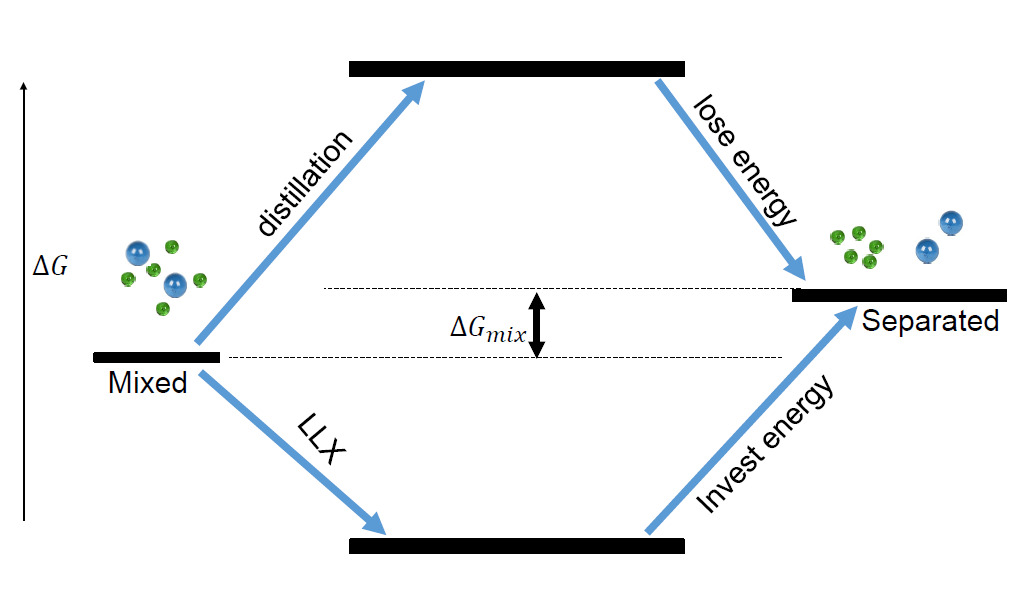
Separations intrinsically require energy, it is our mission to find the most efficient separations for a range of (bio)refinery, fine chemicals and pharma applications. As is visible in the figure, for liquid-liquid extraction as also for other affinity separations that are spontaneously, the Gibbs energy must be negative. That also means that after the separation, the required Gibbs energy to regenerate is more than it was before the primary separation.
How can they be energy efficient then? –> it is all about efficiency in the separation. The Gibbs energy gives the absolute minimum amount of energy needed, but for a real process, the Gibbs energy divided by the efficiency of the separation is the total energy needed.

2. The process efficiency is as important as the Gibbs energy
In any process, perfect reversibility is not possible, and not desired (perfectly reversible processes may take very long and require large equipment, in real processes we accept that some energy is dissipated, and the overall efficiency is lower.

For most separation processes, to elaborate on the separation efficiency is not so easy. In an attempt to make separation process efficiency insightful, we have tried to elaborate on the minimum required energy for different types of separation processes. As starting point, before addressing other types of separation, we examined the working horse of the chemical industry: distillation. We did this by comparing the distillation tower with a Carnot engine. Hign temperature energy is entering the process in the reboiler, and low temperature energy is leaving in the condensor. The difference in the work potential in the reboiler and the condensor is the separation work done by the process. In this approach, the total efficiency was fractionated into a term called the Carnot efficiency and a term called internal energy.

3. Insight in internal efficiency provides guidelines for distillation
For one of the simplest distillation processes, a binary distillation of a mixture fed as a liquid at its boiling point and with ideal thermodynamic behavior, a relation was developed (Blahusiak et al, 2016)

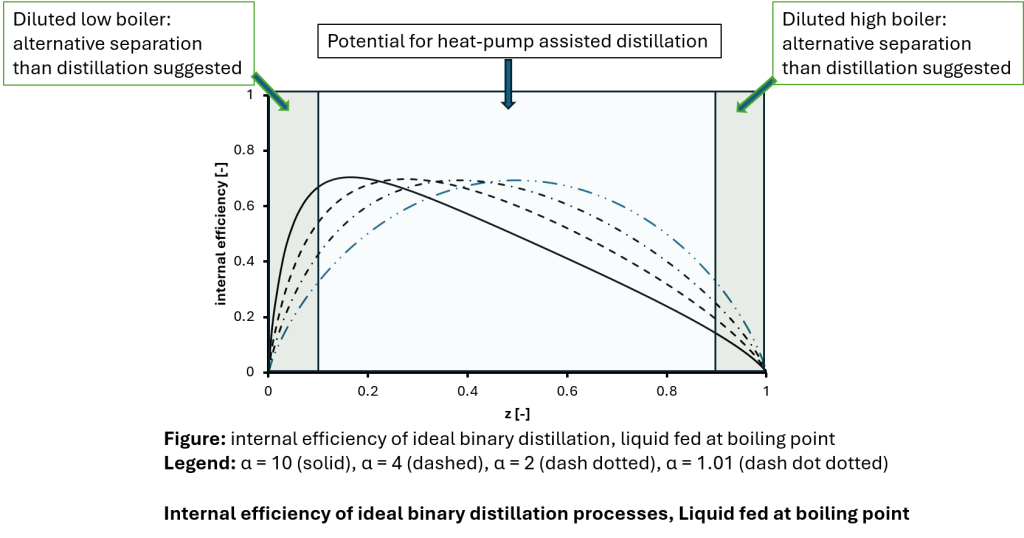
Plotting this equation over the binary composition range 0 < x < 1 for several values of the relative volatility, it becomes clear that the maximum internal efficiency is for each relative volatility around 70%. The locus of the maximum shifts to the left with increasing relative volatility. The figure below shows this. And, including some considerations on Carnot efficiency, guidelines for “to distill, or not to distill” follow from this.
Considering that a process with a (very) low Carnot efficiency operates with a condensor temperature that is not so far under the reboiler temperature, heat pumps may be installed to lift the temperature of the distillate vapor stream, and use that to power the reboiler (at least partially). Thus, using a heat pump, we can make a process with a low Carnot efficiency much more efficient than the Carnot efficiency would predict!! Up to 70% energy savings are known. But how much energy can really be saved? That is also dependent on the internal efficiency, because at low internal efficiency, the overall efficiency will remain low! This leads to a very general guideline that at dilute low boiler and dilute high boiler compositions, no distillation should be used, while for compositions more close to equimolar feeds, heat pump assistance on distillations can make them often so effective and efficient that it does not make sense to try and beat that with other techniques such as extraction or membrane separations.